
At the start of every academic year, I get asked the exact same question by my students specializing in Control Engineering and Industrial Automation: “Professor, which AI is best for students to use for their coursework?” Every year, providing a clear answer becomes significantly more complex. Back in 2024, the landscape was relatively straightforward. In 2027, with ChatGPT, Claude, and Gemini having all evolved dramatically, answering which AI is best for students requires a serious, well-documented, and thoroughly honest analysis.
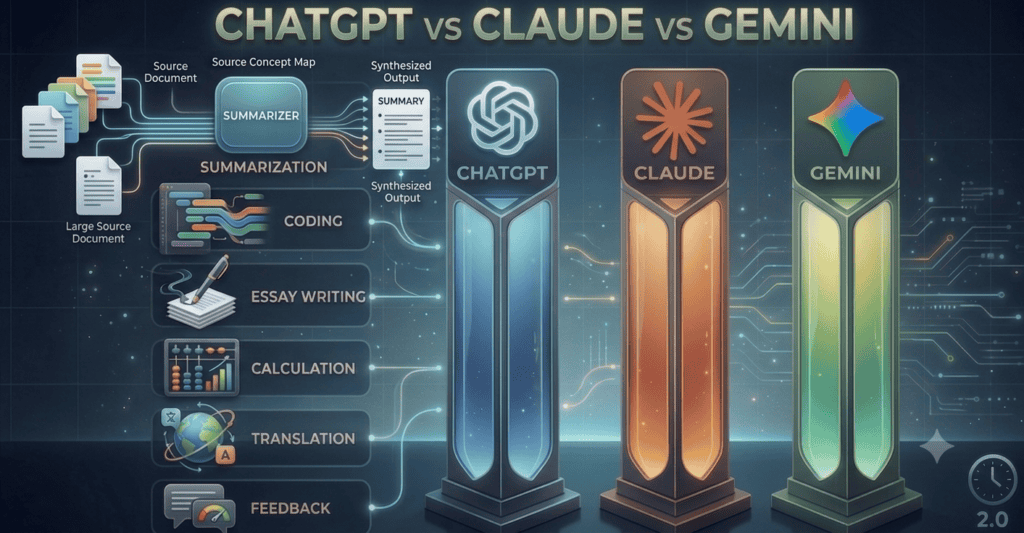
I decided to undertake this research myself rather than rely on third-party reviews. Instead of skim-reading superficial online comparisons—dozens of which are either outdated or clickbait—I spent six full weeks systematically testing ChatGPT, Claude, and Gemini on real academic tasks that my university students tackle every single day. These tasks included summarizing peer-reviewed IEEE papers, debugging MATLAB scripts, writing argumentative essays, executing complex mathematical calculations, performing academic translations, and evaluating student assignments.
This in-depth investigation resulted in this comprehensive guide. My goal is simple: to help you conclusively determine which AI is best for students so you don’t have to waste ten hours testing these tools yourself. Your time as a student is far too valuable.
Methodology: How I Evaluated Which AI Is Best for Students
Before diving into the detailed results, let me outline my testing protocol. Deciding which AI is best for students cannot be achieved through artificial benchmarks or generic trivia questions.
I used actual assignments submitted by my 3rd-year Bachelor’s (L3) and Master’s (M1) students in Control Engineering. For each test, I provided the exact same prompt across all three platforms, within the same browser session, on the same day, eliminating temporal variations or version discrepancies.
The Evaluated Models
- ChatGPT: GPT-4o (Free and Plus plans)
- Claude: Claude Sonnet 3.5 / 4 (Free and Pro plans)
- Gemini: Gemini 1.5 Pro (Free and Advanced plans)
Each output was evaluated against four rigorous criteria: technical accuracy, pedagogical clarity, practical utility, and transparency regarding model limitations. These criteria ultimately define which AI is best for students under real academic pressures.
Task #1: Scientific Literature Summarization
The Test
I submitted an 800-word excerpt from a recent IEEE journal paper on the stability of fractional-order systems to all three tools.
- Prompt: “Summarize this scientific paper in 200 words while retaining all essential technical concepts, equations, and mathematical assumptions.”
The Results
ChatGPT (8/10)
ChatGPT delivered a well-structured, fluent, and technically accurate summary. It correctly retained specialized terminology (such as the Caputo derivative, asymptotic stability, and OSL conditions) without oversimplifying the underlying theory. However, it slightly glossed over a critical nuance regarding boundary stability conditions that the paper explicitly highlighted. When asking which AI is best for students who need quick, clean summaries of scientific papers, ChatGPT performs reliably.
Claude (9/10)
Claude produced the most technically precise summary of the three. Beyond retaining all core concepts, it explicitly called out a methodological limitation noted in the paper—a crucial point that both ChatGPT and Gemini overlooked. Intellectual honesty of this caliber is invaluable in academic literature reviews. Claude excels with dense academic prose. If you are debating which AI is best for students specifically tasked with summarizing scientific papers, Claude is my top recommendation.
Gemini (7/10)
Gemini generated an acceptable summary, but its output was noticeably more generalized. It tended to round off precise technical formulations into broader descriptions. While sufficient for an introductory overview, it lacks the rigor required for an exhaustive academic literature review.
Task #1 Verdict: Claude > ChatGPT > Gemini
Task #2: Code Generation and Debugging
The Test
I assigned a practical laboratory exercise that my engineering students frequently encounter:
- Prompt: “Write a MATLAB script that simulates the step response of a second-order system with variable damping ratios, and plot the curves for ζ = 0.3, 0.7, and 1.2. Include clear axis labels, legends, and inline comments.”
After generating the initial script, I intentionally introduced a syntax error into each code snippet and asked the models to identify and fix the bug.
The Results
ChatGPT (9/10)
ChatGPT generated clean, heavily commented, and fully functional MATLAB code on its first attempt. The plotted variables were correctly parameterized, and the formatting adhered to standard engineering practices. During the debugging phase, it identified the syntax error instantly and explained the fix with exceptional clarity. When evaluating which AI is best for students focused on computer science or engineering coursework, ChatGPT’s integrated Advanced Data Analysis interpreter gives it a distinct advantage.
Claude (8/10)
Claude produced exceptionally structured code accompanied by outstanding pedagogical inline comments—arguably the best explanatory text of all three tools. For a student learning programming fundamentals, these detailed comments are immensely beneficial. Its debugging capability was equally sharp. It placed slightly behind ChatGPT only because its code execution environment is less tightly integrated into the main chat window.
Gemini (7/10)
Gemini generated functional code, but its inline documentation was sparse. While it successfully spotted the introduced bug during debugging, it failed to thoroughly explain why the error occurred. This makes it less effective pedagogically for students striving to master programming concepts.
Task #2 Verdict: ChatGPT > Claude > Gemini
Task #3: Academic Essay Writing and Structuring
The Test
I presented the models with a complex, cross-disciplinary essay topic that bridges control theory and environmental policy:
- Prompt: “Provide a detailed outline and a 300-word introductory paragraph for an academic essay on the following topic: ‘Do automated control systems play a decisive role in the industrial energy transition?'”
The Results
ChatGPT (8/10)
ChatGPT generated a balanced three-part outline complete with relevant sub-topics. Its introductory paragraph flowed smoothly, featuring an engaging hook and a well-defined thesis statement. Its main weakness was a reliance on somewhat generic industry examples rather than specific technical applications. For students who want to leverage ChatGPT effectively for essay writing, our guide ChatGPT Prompts for Essays: 3 Copy-Paste Magic Formulas to Get Started in 5 Minutes provides ready-to-use formulas to overcome writer’s block and structure your arguments efficiently.
Claude (9/10)
Claude provided the most nuanced outline by far. Its sub-sections integrated concrete, real-world engineering examples—such as smart grid load balancing, PID control optimization in wind turbines, and thermal regulation in data centers—that significantly elevated the depth of the essay. The introduction was academically rigorous and built around a strong dialectical framework. In terms of which AI is best for students tasked with writing university-level essays, Claude’s depth of argumentation is unmatched.
Gemini (8/10)
Gemini performed surprisingly well on this task. It proposed an original outline with a unique perspective, focusing heavily on the macroeconomic implications of industrial automation. If you are looking for an unconventional angle to make your university paper stand out, Gemini offers valuable insights.
Task #3 Verdict: Claude > ChatGPT = Gemini
Task #4: Advanced Mathematical Problem Solving
The test
To test mathematical reasoning, I posed a multi-step problem typical of an advanced university engineering exam:
- Calculate the Laplace transform of f(t) = t²·e^(-3t)·cos(2t)
- Determine the system poles for the transfer function H(s) = (s+2)/((s²+4s+8)(s+1))
- Conclude on the BIBO (Bounded-Input, Bounded-Output) stability of the system.
Evaluating mathematical accuracy is paramount when determining which AI is best for students enrolled in STEM disciplines.
The Results
ChatGPT (8/10)
ChatGPT correctly solved the Laplace transform (Step 1) and accurately identified the system poles (Step 2). However, in Step 3, its conclusion regarding stability was correct in outcome but lacked mathematical rigor. It failed to explicitly state the formal stability criterion (that all poles must strictly reside in the open left-half of the complex s-plane). While ChatGPT is generally reliable for mathematics, its formal proofs should always be double-checked.
Claude (9/10)
Claude not only calculated every step accurately but also presented the intermediate algebraic steps with exemplary mathematical formalization. It explicitly cited the relevant stability criteria and pointed out that the complex conjugate poles (s = -2 ± 2j) possess strictly negative real parts (-2), confirming BIBO stability. This level of rigor mirrors what university professors expect on a Master’s-level exam. If you are wondering which AI is best for students taking advanced math, physics, or engineering courses, Claude excels here.
Gemini (7/10)
Gemini committed an algebraic error during the Laplace transformation in Step 1 by dropping a term during polynomial expansion. Although its work for Steps 2 and 3 was logical based on its prior step, the initial error compromised the solution. In an academic exam, this mistake would lead to a loss of marks. Gemini remains less reliable than its competitors for complex symbolic math.
Task #4 Verdict: Claude > ChatGPT > Gemini
Task #5: Academic Language Translation
The Test
I provided a technical paragraph from one of my own published IEEE research papers in English and asked the models to translate it into formal academic French, followed by a reverse translation of an academic text from French into publication-ready English.
- Prompt: “Translate this text while preserving academic tone, formal syntax, and specialized domain terminology. Do not simplify technical expressions.”
The Results
ChatGPT (8/10)
ChatGPT delivered strong translations in both directions. It preserved academic tone and avoided common literal translation traps or false friends. For international students preparing manuscripts for English-language journals, ChatGPT offers natural, professional phrasing. This capability is a crucial factor when deciding which AI is best for students studying in a second language.
Claude (9/10)
Claude consistently produced the most natural, idiomatic academic prose. Its phrasing reads like native academic writing; native English peer reviewers would not suspect the text had been translated by software. For French-to-English or Spanish-to-English academic translation, Claude is my primary tool of choice due to its mastery of stylistic nuances.
Gemini (8/10)
Gemini performed admirably, benefiting from its deep integration with Google’s linguistic models. For lesser-known languages or multilingual research papers, Gemini holds a slight edge. On standard English-French academic translations, it performed on par with ChatGPT.
Task #5 Verdict: Claude > ChatGPT = Gemini
Task #6: Pedagogical Feedback on Student Work
The Test
I uploaded an anonymized assignment submitted by a student analyzing Lyapunov system stability, containing deliberate conceptual and mathematical errors.
- Prompt: “Analyze this student’s response, identify conceptual and methodological errors, and construct constructive feedback that helps the student understand where they went wrong.”
Determining which AI is best for students also extends to how effectively these tools function as private tutors providing actionable feedback.
The Results
ChatGPT (8/10)
ChatGPT correctly identified 4 out of the 5 errors in the student’s submission. Its feedback was structured encouragingly. However, it missed a subtle error concerning the positive definiteness domain of the candidate Lyapunov function—a detail that requires domain-specific familiarity to catch.
Claude (10/10)
Claude identified all 5 errors, including the subtle domain constraint. More impressively, it categorized the mistakes into conceptual misunderstandings versus simple arithmetic slips. It structured its feedback into three sections: what was executed correctly, what needed immediate correction, and foundational concepts requiring review. This reflects the precise structure university educators use when grading. Regarding which AI is best for students seeking a personal virtual tutor, Claude operates in a league of its own.
Gemini (7/10)
Gemini identified only 3 out of 5 errors and provided generalized feedback that lacked specific references to the equations in the text. While sufficient for a quick sanity check, it falls short as a comprehensive learning tool.
Task #6 Verdict: Claude > ChatGPT > Gemini
Summary Table: Score Breakdown Across Tasks
To help you decide which AI is best for students based on your specific academic needs, here is the full score breakdown:
| Task / Academic Need | ChatGPT | Claude | Gemini | Top Performer |
| 1. Scientific Summaries | 8/10 | 9/10 | 7/10 | Claude |
| 2. Coding & Debugging | 9/10 | 8/10 | 7/10 | ChatGPT |
| 3. Essay Writing | 8/10 | 9/10 | 8/10 | Claude |
| 4. Complex Mathematics | 8/10 | 9/10 | 7/10 | Claude |
| 5. Academic Translation | 8/10 | 9/10 | 8/10 | Claude |
| 6. Pedagogical Feedback | 8/10 | 10/10 | 7/10 | Claude |
| Overall Average Score | 8.2 / 10 | 9.0 / 10 | 7.3 / 10 | Claude |
Final Verdict: Which AI Is Best for Students in 2027?
After six weeks of systematic testing across real university tasks, here is my definitive answer regarding which AI is best for students in 2027.
If You Can Choose Only One Tool: Claude Is the Clear Winner
The data is conclusive: Claude wins 5 out of the 6 evaluated categories. Its academic rigor, mathematical precision, nuanced prose, and superior feedback make it the single best tool for higher education, especially for students in STEM, humanities, and research-heavy disciplines.
What sets Claude apart in this evaluation of which AI is best for students is its refusal to generate overly wordy, generic filler. It is concise, precise, and transparent about its limitations—essential qualities for students aiming to actually learn rather than just complete assignments.
However, selecting Claude is only half the equation; you must also configure it effectively. Once you know which AI is best for students, learning how to turn it into a personalized study assistant tailored to your specific courses, syllabus, and exams is the next logical step.
For Heavy Programmers: The Claude + ChatGPT Dual Setup
If your coursework heavily involves software engineering, Python, MATLAB, or C++, ChatGPT retains a slight edge due to its native code execution environment. The ideal workflow for technical students is using Claude for writing, research, and mathematical derivations, while using ChatGPT for coding and debugging sessions. Many of my engineering students adopt this dual approach, representing the most effective practical solution when deciding which AI is best for students in technical majors.
On a Zero Budget: ChatGPT Free Version
If you cannot afford a paid subscription, ChatGPT’s free tier (GPT-4o mini / GPT-4o free allocation) offers the most generous daily message limits. For students seeking the best free option without spending money, ChatGPT provides broad utility across everyday tasks.
The Case for Gemini: When Should You Use It?
While Gemini was not the top overall winner in this test, it offers two distinct advantages:
1. Video Summarization: Gemini can process and summarize long YouTube lectures, extracting key bullet points from recorded university classes better than its competitors.
2. Google Workspace Integration: If your university relies on Google Drive, Docs, and Gmail, Gemini integrates seamlessly into your existing workflow.
The Factors Traditional AI Comparisons Overlook
In answering which AI is best for students, we must consider several critical operational factors that standard technical benchmarks often ignore.
1. The Learning Curve
Each AI model responds differently to user input. Claude requires detailed, well-contextualized prompts to yield optimal results. ChatGPT is more forgiving of ambiguous or short queries. Gemini is the most intuitive for complete beginners. Consequently, determining which AI is best for students also depends on your willingness to master prompt engineering.
2. Data Privacy and Confidentiality
A topic students rarely consider is data security. Your uploaded essays, code repositories, and problem sets are processed on third-party servers. Each platform operates under different privacy policies. If you are conducting sensitive research or working under a Non-Disclosure Agreement (NDA) with an industry partner, evaluate privacy terms carefully before choosing your primary tool.
3. Model Evolution
This comparison reflects testing conducted in mid-2026. Because OpenAI, Anthropic, and Google update their models frequently, the rankings may shift over time. I will update this article biannually to keep these recommendations current.
Final Recommendations by Academic Profile
To provide a personalized summary on which AI is best for students, here are my recommendations tailored to specific academic paths:
- STEM & Engineering Students: Primary tool: Claude (for mathematical rigor, paper analysis, and reports). Secondary tool: ChatGPT (for code generation and execution).
- Humanities, Law, & Social Sciences: Primary tool: Claude. Its ability to construct nuanced arguments, handle complex textual analysis, and draft fluid prose makes it ideal for long-form academic writing.
- Business & Economics Students: Primary tool: ChatGPT for quantitative analysis and spreadsheet modeling; Claude for report writing and case study analysis.
- Undergraduate Students (Years 1–2): Primary tool: ChatGPT Free. It offers high accessibility and sufficient capability for foundational university coursework.
- Ph.D. Candidates & Academic Researchers: Primary tool: Claude for paper drafting and deep textual synthesis, paired with Perplexity AI for real-time literature searching.
For doctoral candidates leveraging the Claude + Perplexity combination, integrating citation mapping tools like Litmaps is highly recommended. Litmaps visualizes connections between academic papers via citations, allowing you to start from a single seed paper and generate interactive maps of foundational literature, recent developments, and key researchers in your field.
Conclusion
The question of which AI is best for students in 2027 is no longer about finding a single tool that excels at everything, but rather choosing the right tool for specific tasks.
To summarize: Claude leads in overall academic quality and reasoning, ChatGPT excels in programming and versatility, and Gemini shines in Google ecosystem integration and media analysis.
While using all three offers a complete toolkit, Claude remains my #1 recommendation if you must choose a single AI platform for higher education.
Ultimately, six weeks of systematic testing reinforced an essential truth: these tools do not replace student thinking—they accelerate, structure, and refine it. The most successful students are not those who rely on AI the most, but those who use it critically, strategically, and ethically. Answering which AI is best for students is ultimately about developing digital maturity in your academic workflow.
Author’s Note: This comparative study was conducted between June and August 2026 using the model versions available during that window. Model capabilities evolve rapidly. This article is updated biannually to maintain accuracy. Tests were conducted in my capacity as a higher education researcher and professor in Control Engineering using real academic coursework.
Written by: Assaad Jmal – PhD, University Lecturer and Researcher

- Best AI Grading Tools for Teachers: Grade 2x Faster (Top 5 Tested) - 17 October 2026
- Which AI Is Best for Students in 2027? Our Comparison Across 6 Real-World Tasks (Summarizing, Coding, Essays, Math, Translation, Feedback) Saves You 10 Hours of Research - 10 October 2026
- How to Design AI-Proof Assessments: The Complete Guide with 5 Proven Methods for ChatGPT-Resistant Assignments - 2 October 2026